13th May 2026
What is “Joyspan”? New Wellness Trend Taking Over The World.
Why the most interesting longevity metric isn’t measured in years
There is a new word in longevity circles, and it is considerably better than most of them.
It is Joyspan.
Coined by the American gerontologist Dr Kerry Burnight in her 2025 book of the same name, Joyspan is what you get when you add lifespan and healthspan together and then ask a question almost nobody in the wellness industry asks: of the years you are going to live, and of the years inside that figure you will spend in reasonably good health, how many of them will actually feel good?
It is a deceptively simple framing. And like most deceptively simple framings, it quietly indicts the entire category it belongs to.
Lifespan is straightforward. Healthspan is the more recent upgrade. The slice of your life lived without significant disease or disability. Both are eminently measurable. Both have spawned enormous industries, with cold plunges, continuous glucose monitors, and supplement stacks costing the equivalent of a mortgage payment. The premise is that if you optimise the inputs, you extend the outputs, and a longer, healthier life results.
The premise is also, on its own, slightly mad.
Because as Burnight points out: longevity is meaningless if you don’t like your life. A century of years spent feeling unrecognised, disconnected, bored and afraid is not a prize. It is a sentence served slowly.
So the question becomes: what actually produces a life worth wanting more of?
The Joyspan Matrix
Burnight’s answer is what she calls the Joyspan Matrix — four daily actions that, across thousands of variables in the gerontology literature, kept turning up as the things that distinguish people who thrive in the second half of life from people who endure it.
The four are: Grow. Connect. Adapt. Give.
Grow — keep developing as a person. Pick up something new. Take a class. Stay curious in a way that costs you something.
Connect — invest in relationships. The old ones and the new ones. The deep ones and the casual ones. Loneliness, by now, is so well-established as a mortality risk that the World Health Organization has stood up a Commission on Social Connection, and University of Sydney researchers estimate the Australian economic burden of loneliness at $2.7 billion a year in healthcare costs alone, before you start counting lost productivity.
Adapt — get good at the small art of adjusting. Retirement, illness, loss of friends, loss of status, loss of certainty. The people who do well don’t avoid these; they get more flexible inside them.
Give — share yourself. Time. Attention. Skill. Burnight is clear that this isn’t sentimental. Giving has been measured, repeatedly, as one of the most reliable predictors of late-life flourishing in the literature.
Genes, according to the studies Burnight draws on, account for roughly 25% of the variation in lifespan. The other 75% sits inside beliefs, attitudes, choices and behaviours. Becca Levy’s research at Yale found that people who held positive beliefs about their own ageing lived, on average, seven and a half years longer than those who did not. Seven and a half years. From a belief.
This is the kind of number that, if it came in a pill, would be the most prescribed drug in human history.
The thing the books leave out
Here is where it gets interesting, and where I want to make a slightly heretical argument.
Joyspan, as a concept, is one of the best things to come out of longevity science in a decade. The matrix is sound and the research is real. The framing, that you can grow your joyspan in a way you cannot grow your lifespan, is useful.
But there is a quiet omission in almost everything written about it.
The implicit answer to how you grow, connect, adapt and give is almost always a program. A class. A book group. A volunteering rota. A coaching curriculum. A daily journaling practice. A gratitude exercise. An app.
All of these can work. None of them are the most efficient unit of delivery.
Because if you wanted to design, from scratch, a single experience that activated all four pillars of the Joyspan Matrix in the same afternoon, you would not invent a program.
You would invent a hike.
What a properly designed hike actually does
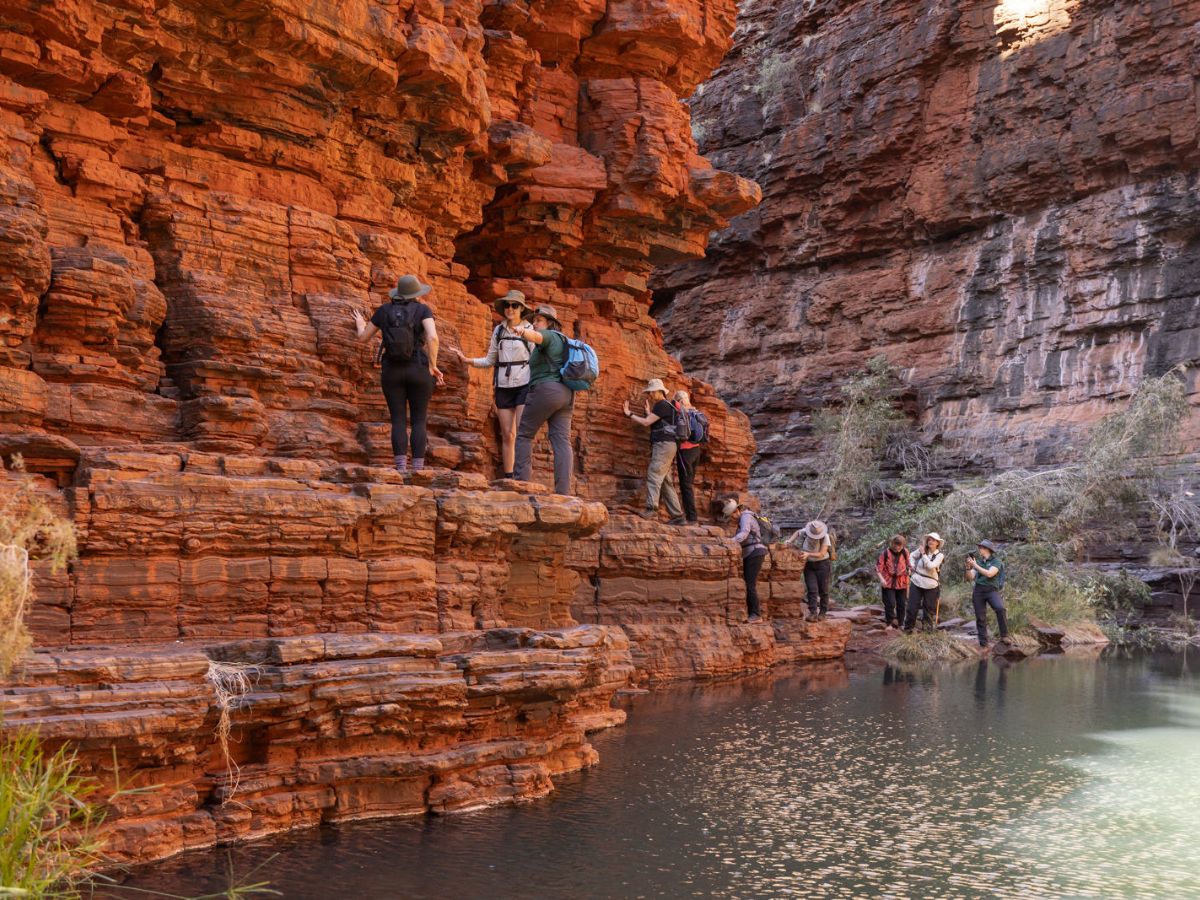
I have spent the last decade watching this happen on Perth trails, in Karijini gorges, and on the Bibbulmun Track.
Grow. You learn the country you are walking through – the geology of the gorge, the name of the tree, the story of the place. You are out of your office and inside terrain that doesn’t behave like your office. New cognitive territory, by definition.
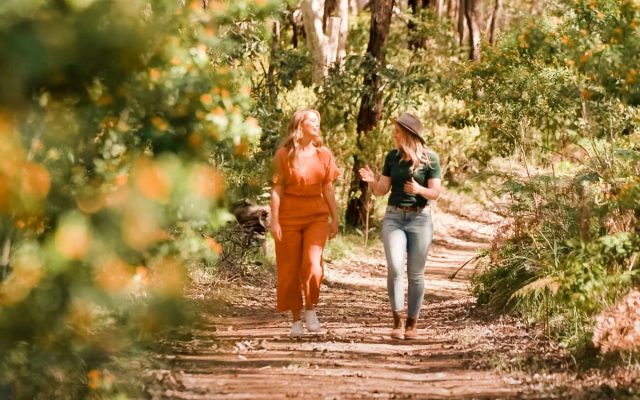
Connect. You walk beside someone for four hours. Walking shoulder-to-shoulder, side by side rather than face-to-face, is one of the most psychologically permissive postures humans have invented. People say things on hikes they would never say across a table. The conversation is not the product. The walking is the product. The conversation is what walking makes possible.
Adapt. The weather changes. The pace shifts. The terrain asks something different of your knees than your last meeting did. Your nervous system practises adjustment in real time, on a scale small enough not to overwhelm and large enough to count.
Give. You hand someone the water bottle. You walk a slower person’s pace without making a thing of it. You point out the bird. You wait at the top. The micro-economies of generosity on a trail are so normal nobody comments on them, which is precisely why they work.
The mediator nobody mentions
There is one more piece of research worth knowing, because it sharpens the point considerably.
A 2025 study published in the International Journal of Environmental Research and Public Health asked a question that the wellness industry has been confidently sidestepping for a decade: does being in nature actually produce wellbeing, or does it produce something else that produces wellbeing?
The answer, statistically, was the second one. The relationship between time in nature and improved psychological wellbeing was significantly mediated by awe and gratitude. Not directly caused by the trees. Caused by what the trees made people feel.
Or, as the researchers put it more bluntly than researchers usually do: “merely being in nature does not substantially affect well-being.” The effect runs through the noticing.
This is the bit that matters. The forest does not heal you because it is a forest. The forest heals you because being inside it, for long enough, with the right kind of attention, generates the emotional states — awe, gratitude, the sense of being small inside something large — that the human nervous system is calibrated to be repaired by.
The corollary is uncomfortable for a lot of wellness operators: you can be in nature and get nothing from it. You can also be in nature briefly, attentively, well-guided, and get an enormous amount.
The place is the variable, but the place has to be worked.
Joyspan, locally
Burnight writes Joyspan from an American gerontology context, with people in their seventies and eighties in mind. The four pillars apply at every age. They apply to the thirty-five-year-old corporate manager who has not had a curious thought outside a screen in eleven months. They apply to the forty-eight-year-old founder running on cortisol. They apply to the school principal, the surgeon, the retiree, the new mother.
If place is the most underleveraged variable in human capacity — and I think it is — then Joyspan is the most underleveraged frame for thinking about what we actually sell.
We are selling concentrated doses of the four things that, in the longest-running studies of human flourishing, predict whether the years you are going to live will feel like a gift or a sentence.
Joyspan is a brilliant concept. It is also, on closer inspection, the thing we have been quietly delivering since 2016.
We just didn’t have the word for it yet.
The Hike Collective designs nature-based experiences for corporate teams, private groups, and individuals across Kings Park, Wadjemup (Rottnest Island), the Perth Hills, the Great Southern and Karijini. Every paid experience contributes a portion of revenue to the Wild Access Project, which keeps community hikes free for those who couldn’t otherwise justify the spend.