8th December 2025
Beyond Hybrid: Rethinking Where Connection Actually Happens
For the better part of a decade, the debate about the future of work has circled the same question: Where should people work?
At home?
In the office?
Or somewhere in between?
Hybrid work has become the compromise of our era. A negotiated middle ground between productivity, flexibility, and culture. And yet, despite thousands of articles, executive memos, return-to-office campaigns, and remote-work manifestos, something essential has been overlooked.
A recent longitudinal study following more than 16,000 Australian workers confirms what many employees have quietly known: hybrid arrangements support mental health far better than rigid structures do. The benefits were most pronounced for women and for employees who were already struggling, groups who often carry a disproportionate share of cognitive and emotional load.
Crucially, the study showed that hybrid work doesn’t improve wellbeing because the office is inherently good or the home is inherently good. It improves wellbeing because flexibility creates space. Space to breathe. Space to adjust. Space to work in ways that match the rhythms of real life.
But this is where the current conversation runs out of road.
Flexibility has helped us rethink the where of work, yet we still haven’t examined the where of connection.
And the two are not the same.
The Blind Spot in the Hybrid Work Debate
If hybrid work has taught us anything, it’s that proximity does not guarantee connection. Sitting in the same office doesn’t automatically bring teams closer, and working from home doesn’t necessarily isolate them.
The real challenge is not location.
The real challenge is relational capacity.
How do teams build trust, cohesion, and shared understanding when their time together, wherever it happens, is squeezed between deadlines, deliverables, and digital noise?
This is the missing piece in the hybrid debate:
Connection requires a different kind of environment than work does.
And right now, most organisations are unintentionally designing their workplaces around tasks rather than teams.
We optimise for efficiency, not attunement.
We optimise for output, not belonging.
We optimise for meetings, not meaning.
Yet human connection is what stabilises teams under pressure, reduces burnout, supports psychological safety, and strengthens performance over time.
Which raises a simple but radical question:
What if the best place to rebuild team cohesion isn’t the office or the home, but somewhere that isn’t either?
What Happens When Teams Connect Outside the Office
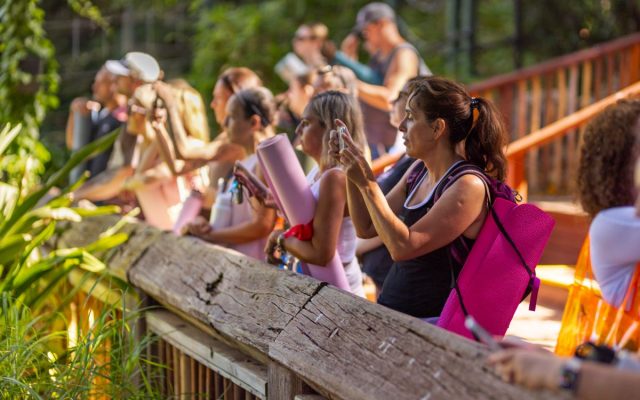
For more than ten years, I’ve watched teams step into wild spaces across Western Australia. Not for ropes courses or orchestrated trust falls, but for something far simpler: walking together.
The patterns are incredibly consistent. In nature, people talk differently, listen differently and relate differently entirely because the environment does the heavy lifting for them.
In the absence of walls, hierarchy softens.
In the presence of movement, thinking clears.
In the presence of real sensory input like light, air, texture, and space, the nervous system finds a steadiness that is almost impossible to access in traditional work settings.
When people walk side by side, rather than sit face to face, conversations become more honest and more spacious.
Social pressure reduces.
Internal noise settles.
Creative thinking re-emerges.
It is not “team building” in the corporate sense.
It is team human-ing.
It is the simple act of placing people in an environment where their physiology supports the very behaviours workplaces keep trying to engineer: trust, collaboration, openness, clarity.
These are not soft concepts. They are the infrastructure of effective teams.
Why Current Workplace Solutions Fall Short
Organisations are trying to solve human problems with structural answers:
“Come back to the office.”
“Stay home, it’s more productive.”
“Let’s try two days in, three days out.”
But none of these configurations address the real issue:
connection cannot be mandated by policy.
It can only be created through experience.
Workplaces have become very good at designing spaces for focus, meetings, and efficiency. They have become far less effective at designing environments that support the deeper, relational layers of work. Yet those layers are what hold teams together when pressure rises.
The office is not designed for that.
The home is not designed for that.
Zoom certainly isn’t designed for that.
Which is why we need a third space.
The Third Space: Together, But Not at Work
If hybrid work is here to stay (and all indicators suggest it is) the next evolution is not a new ratio of remote versus in-office days. It is the intentional creation of connection days: time spent together outside the structures, pressures, and routines of the workplace.
Not offsites with lanyards, forced fun, or corporate-style “team bonding”. But genuine shared experiences in environments that naturally support:
psychological recovery
emotional regulation
clearer thinking
deeper listening
relational trust
collective capacity
These are conditions for sustainable performance, not luxuries! When teams connect in nature, not as a break from work, but as part of how they work, they develop a level of cohesion that carries back into the office, the home, and every digital space between them.
This is not an argument against offices or remote work. It is an argument for adding what’s missing.
Connection lives in experiences, not locations. Belonging grows in environments that support it. And right now, wild spaces remain one of the most underutilised wellbeing and performance assets available to workplaces.
A New Question for Leaders
The hybrid debate has centred on productivity, logistics, and policy. But the next phase of the conversation is far more human.
Not:
Where should people work?
But:
Where should people connect?
Not:
How do we get people back together at work?
But:
How do we create the conditions where people actually feel connected?
Because in the end, high-performing teams are not built solely through structures or schedules, but through shared human experiences that restore trust, clarity, and cohesion. And sometimes, the most effective place for that to happen isn’t in the office at all, but outside. Moving, breathing, thinking, connecting in the kind of environment that reminds people who they are when they’re not performing.
The future of hybrid work is not just flexible.
It’s relational.
And it might begin somewhere as simple as a trail.
Explore your team’s connection capacity
If you’re curious how your workplace environment is supporting (or straining) wellbeing, clarity, and cohesion, you can take our free Team Health Check.
It offers a simple snapshot of your team’s current capacity, and where small shifts could make a big difference.