1st August 2026
Orchids Worth Knowing: The Flower That Seduces a Wasp
Somewhere in the bushland around Perth, this very week, a small, dark red flower is telling an outrageous lie. It has shaped its petals, tuned its perfume and cocked a hinged trap, all to persuade a male wasp of one specific thing: that it is a female wasp, willing and waiting. And the wasp, this is the tragic part, is going to believe every word of it. This is the hammer orchid, and its confidence trick is one of the most astonishing things happening anywhere in the Western Australian bush right now. It is also merely the opening act.
Western Australia is one of the great orchid provinces of the Earth: more than 400 native species, a great many found nowhere else, and new ones still turning up. For the wildflower hunter they are the ultimate quarry — small, secretive, frequently exquisite, and desperately easy to walk straight past. Learn even a few, and every walk quietly becomes a treasure hunt.
The great orchid con
Let’s stay with that hammer orchid, because it earns the attention. It belongs to a small genus, Drakaea, of about ten species, found only here in the South West. And each species has evolved to deceive one — precisely one — kind of male thynnid wasp. The deception is not approximate. It is forensic.
To understand it, you first have to understand the wasp. Female thynnid wasps are flightless. When a female is ready to mate, she climbs to the top of a grass stem, releases a scent, and waits for a flying male to swoop in, seize her, and carry her off in a nuptial flight. The hammer orchid has reverse-engineered this entire ritual, step by step. Its lower petal is shaped, sized, coloured and textured to resemble a female wasp perched on a stem — and, most cunningly of all, it emits a scent that chemically mimics her sex pheromone. A patrolling male, following that perfume across the bush, arrives at what he is utterly certain is a mate, grabs the decoy, and heaves to fly off with his prize.
That is when the trap springs. The false female sits at the end of a hinge. As the male hauls at her, the hinge flips him up and over in a violent arc, slamming him against the flower’s waiting column, where a packet of pollen is pressed firmly onto his back. Baffled, thwarted, he gives up and blunders off — to the next orchid, where the entire indignity repeats, and the pollen he’s carrying is delivered. The orchid is fertilised. The wasp gets nothing whatsoever but a wasted afternoon and a dab of pollen he never asked for. The commonest species, Drakaea glyptodon, goes by the wonderful common name of “king-in-his-carriage,” and dupes a wasp with the equally splendid name of Zaspilothynnus trilobatus.
Botanists call this sexual deception, and Australia is its undisputed world capital. And notice the sheer economy of it, because this is the part that ought to make you sit up. Most flowers pay their pollinators in nectar — an honest wage, but an expensive one, costing the plant precious sugar it can ill afford on poor soil. The hammer orchid pays nothing. It has discovered that it is cheaper to lie than to pay. It offers no reward at all, only the promise of one, and gets its pollen delivered for free by an insect too besotted to notice it has been swindled. It is, when you think about it, less a flower than a very small, very patient confidence artist.
The orchids to fall for first
You needn’t chase the tricksters to lose your heart to WA orchids. Several are common enough, and lovely enough, to make ideal first acquaintances:
- The cowslip orchid (Caladenia flava) — a cheerful buttery yellow, often flecked with red, and one of the most common and widespread orchids in the state. If you learn one orchid this spring, learn this one; it flowers across a long, forgiving window and turns up almost everywhere.
- Donkey orchids (Diuris) — named for the two “ears” of petals held comically aloft. The winter donkey orchid is a reliable early sight in Perth reserves like Bold Park.
- Sun orchids (Thelymitra) — which, defying every orchid stereotype, open flat and simple like little coloured stars, and only on warm, sunny days. Walk the same track on a cool grey morning and you’ll pass a hundred of them shut tight and never know they were there. They keep their own hours.
- Enamel orchids — glossy, lacquered flowers that look, uncannily, as though they’ve been dipped in paint and hung up to dry.
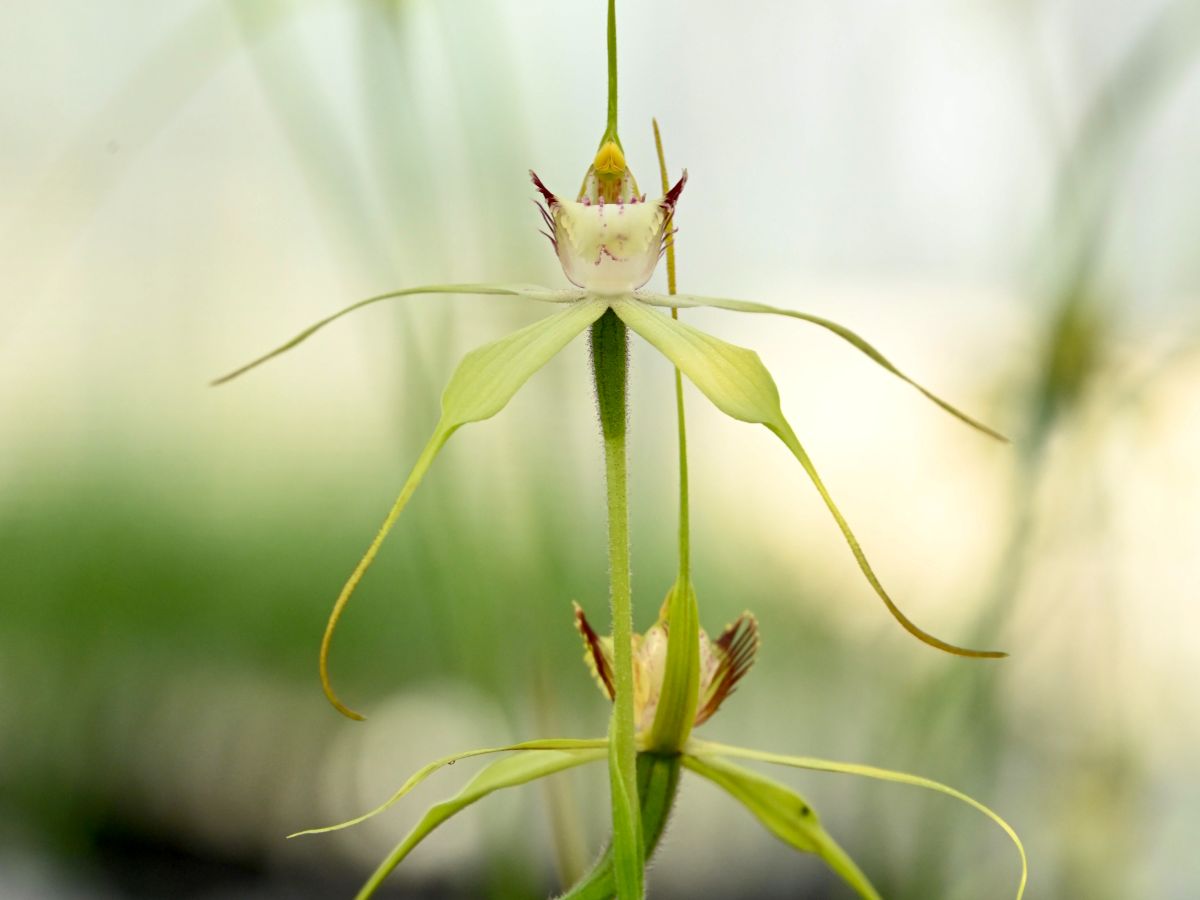
The genus Caladenia, the spider orchids and their kin, is the largest group of orchids in the state, with something like 136 species here alone, and many of them play the same deception games as the hammer orchid, luring male wasps with the same false promises. They’re the ones trailing long, dramatic, spidery petals, looking part flower and part insect, which is precisely the point.
And then there is the one every orchid hunter secretly dreams of stumbling upon: the Queen of Sheba (Thelymitra variegata), a small sun orchid so improbably multicoloured — purples, blues, reds and gold, all at once, all shining — that it looks less like a flower than a jeweller’s mistake. It is one of the rarest orchids in the country, fiercely protected, slow to flower, and finding one in the wild is the kind of thing an orchid person remembers for the rest of their life.
The duck, and the art of finding them
The hammer orchid isn’t the only performer in the deception racket. Look, too, for our duck orchids (Caleana, some of them once split off as Paracaleana) — small flowers so uncannily, comically duck-shaped, bill and cocked head and plump little body all present and correct, that they look like a botanical practical joke. They, too, spring a hinged, touch-sensitive trap that snaps a visiting male down against the pollen. And here is a distinction worth carrying, because it’s exactly the sort of thing that separates an enthusiast from an expert: our little Western Australian duck orchids dupe male wasps, whereas the famous large flying duck orchid of the eastern states, the one that once graced an Australian postage stamp, fools male sawflies instead. Evolution hit on a good con in this corner of the country, then ran it again and again in slightly different costumes.
A word on the craft of actually finding orchids, because it defeats almost everyone at first. Orchids are small, frequently the muted browns and greens of the leaf litter they hide in, and heartbreakingly easy to trample without ever seeing. The knack is to slow to an almost absurd pace, get your eye down low, and scan the ground beside the track rather than the middle distance. Learn the company they keep – many favour particular soils, the sheltered lee of a granite outcrop, or the ground beneath one specific kind of shrub – and you begin to know where to look before you’ve looked. A seasoned orchid hunter will find a dozen where a hurrying walker finds none, and the only real difference between them is pace and attention. Which is, when you think about it, a fair description of most things worth doing in the bush.
Why you must never, ever dig one up
There is a hard rule with terrestrial orchids, and it is rooted in biology, not merely etiquette. Our ground orchids live in an intimate, secret partnership with specific fungi in the soil — a relationship so profound that most orchid seeds, which are little more than dust with no food reserves of their own, cannot even germinate unless their particular fungal partner is present to feed the seedling. The orchid you admire above ground is only the visible half of a two-part organism. Below it, threaded through the soil, is its indispensable other half.
This is why you cannot simply dig up a wild orchid and replant it in the garden. Severed from its fungus, it starves and dies. It is why orchid conservation is so fiendishly difficult, why these plants are so acutely vulnerable to any disturbance of their ground — and why the only responsible way to enjoy them is on your knees, with a camera, leaving every root, tuber and fungal thread exactly where it lies.
Stay on the track. Photograph. Move on. An orchid picked or dug is an orchid killed, and, more often than you’d guess out here, there was only ever going to be a handful of that particular kind in the entire world.