1st July 2026
Kangaroo Paws & the Bird-Fed Bush
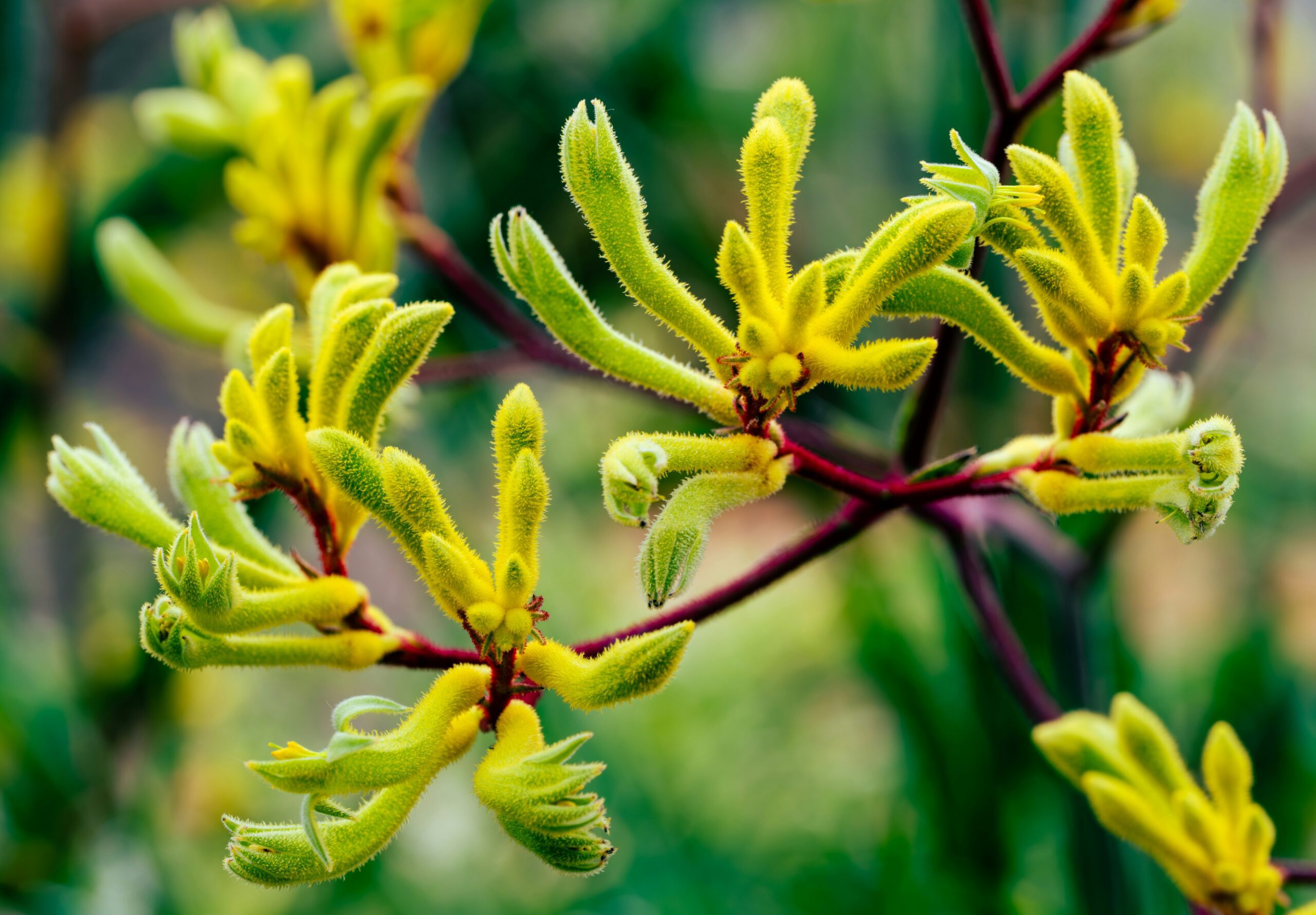
If Western Australia had to choose a single flower to stand for the whole improbable place, it chose shrewdly. The red-and-green kangaroo paw — Anigozanthos manglesii — has been the state’s floral emblem since it was formally proclaimed on the ninth of November, 1960, and you need only look at one to understand the decision. Brilliant green flowers, furred like velvet, ranged in a row up a woolly blood-red stem: unmistakable, faintly theatrical, and quietly one of the most cunning flowers in the entire bush. Because the kangaroo paw, like so much of what grows here, was never designed for insects at all. It was designed, down to the last hair, for birds.
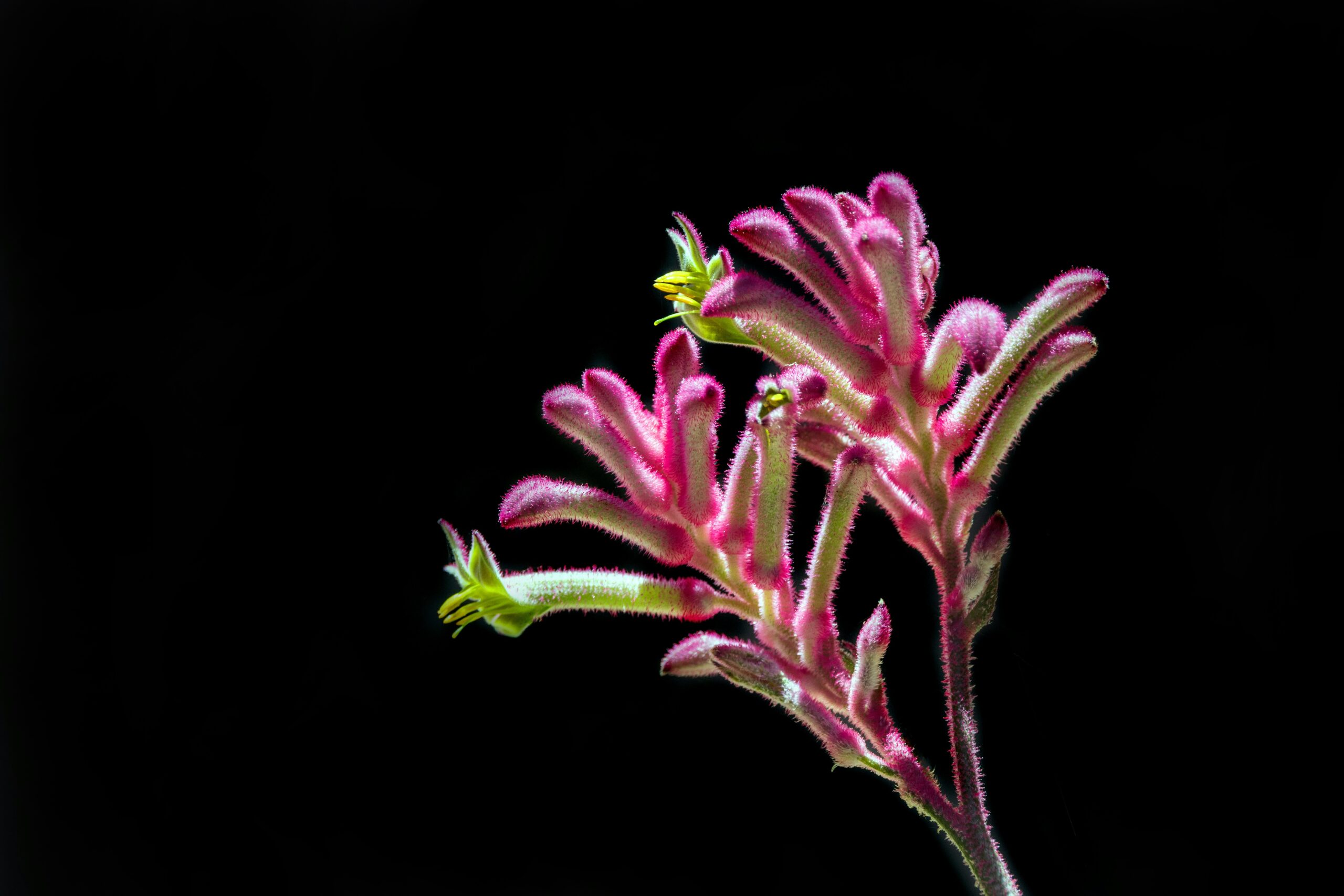
Engineered for a beak
Look closely at a kangaroo paw and you’ll notice what it doesn’t offer. There is no convenient flat landing pad, the way an insect-flower obligingly provides. Instead it presents a long tube, held at a very particular angle, brimming with nectar down at the bottom where only something with a long face can reach it. To claim the reward, a visitor must push its head right inside.
That visitor is a honeyeater. And as the bird probes the tube, the flower dusts a precise patch of pollen onto a precise part of its head or throat — positioned so exactly that when the bird visits the next paw, that pollen brushes off just where it needs to land to fertilise it. It is a delivery system of real elegance. The flower has, in effect, worked out where a honeyeater’s face will be, to the millimetre, and stationed its pollen there to be collected and couriered. The woolly texture, the vivid colour, the sturdy stem strong enough for a bird to grip — none of it is decoration. All of it is bird engineering.
The kangaroo paws are a Western Australian speciality, with around eleven species native to the South West, ranging from that iconic red-and-green through golds and oranges to a smoky, near-black paw. They flower from late winter well into summer, with a particularly strong showing around Perth in September and October. Their Noongar name is kurulbrang. And there is a small colonial footnote worth carrying on the walk: the species name manglesii honours the Mangles family of England, who were among the first to coax the plant into flower in a European glasshouse in the 1830s — a Western Australian icon that was, for a time, more admired in the drawing rooms of Britain than at home.
The bush’s great feeding stations
If the paws are elegant, the banksias are generous on an almost industrial scale. A banksia flower spike isn’t a single flower at all — it’s a dense cylinder of hundreds, sometimes thousands of tiny individual flowers packed together, each one charged with nectar. On the largest species, a single spike can carry several thousand flowers at once. They are, in the plainest terms, the petrol stations of the bush, and they never close.
An enormous cast of animals runs on them. Honeyeaters work the banksias from dawn to dusk. So do the tiny honey possums — extraordinary creatures barely bigger than a mouse, sometimes called by their Noongar name, the noolbenger, that feed almost entirely on nectar and pollen and pollinate the flowers as they scramble from spike to spike. They are among the very few mammals on Earth to live this way, on a diet of pure flower, and they exist essentially only here. In flowering season a banksia woodland is a round-the-clock diner, and every bird and possum moving between the spikes is a pollen courier, unpaid but for the nectar, working the night and day shifts both.
Banksias belong to the same grand family — the proteas — as the grevilleas, hakeas and smokebushes, and between them these plants form the backbone of the bird-fed bush. A quick note for the keen, because it’s the sort of thing that impresses on a walk: you may occasionally see the old name Dryandra attached to some of these plants. Botanists formally folded the dryandras into the banksia genus back in 2007, a change most authorities now accept — though a few distinguished holdouts still argue the point to this day. Even the names out here are alive, and occasionally contested.
A whole economy that runs on nectar
Step back, and a larger picture assembles itself – one that quietly explains half of everything else in this series.
In most of the world, the pollination economy runs chiefly on insects. Here, to a degree found almost nowhere else, it runs on nectar and birds. A whole landscape of tubular, robust, brightly coloured flowers, built to be perched on and drunk from, sustaining a whole community of honeyeaters and honey possums which, in turn, keep the flowers pollinated. It is a bargain struck in the deep past and honoured ever since: the plants supply the fuel, the animals supply the transport, and neither can now do without the other. It also helps explain the bird-red vividness of the bush, the sheer size and sturdiness of the flowers, the nectar practically dripping from the banksias, all of it downstream of that single ancient decision to be fed by birds rather than bees.
In spring you can watch the whole arrangement working in real time, if you stand still long enough. The flash of a wattlebird driving a rival off a banksia. The tremble of a kangaroo paw as something feeds unseen inside it. The frantic, weightless dart of a honey possum you’ll almost certainly never spot. It is not a quiet landscape. It is a landscape doing continuous, noisy, million-year-old business, and the flowers are merely the shopfront.
The kangaroo paw earned its place as the emblem on looks alone. But the better reason, the one worth knowing, is that it stands for the whole quietly astonishing arrangement: a bush that decided, in the deep past, to be fed by birds, and grew beautiful in the long, patient work of persuading them to keep coming back.