26th July 2026
What’s Blooming Now: How to Chase a Spring That Won’t Stand Still
Most of the world is issued a single spring, delivered more or less to a calendar and gone before you’ve properly noticed it. Western Australia was issued something far more useful: a spring that travels. It begins in the warm north while the south is still under cloud, and over four unhurried months it rolls roughly a thousand kilometres southward, arriving in each region like a slow, coloured tide. Which means that at almost any point between June and November, the great show is happening somewhere — and the only real skill is knowing where the wave is breaking this week.
Spring here, in other words, is not a date. It is a rumour that moves south. The reason it moves at all is simple enough, spring is really just warmth and daylight arriving, and both arrive in the north first, but the effect is something close to magic: a single season you can physically follow, the way you might follow a band on tour. This is the map for chasing it.
One honest caveat first, because botany keeps no timetable and rewards no impatience: everything below shifts with the rain. A generous autumn brings the everlastings forward by a fortnight; a dry run pushes the whole procession back. Treat these windows as a reliable rhythm, never a promise. The plants have not read this article.
August – the Mid West lights the fuse
While Perth is still wringing out its socks, the country a few hours north is quietly detonating.
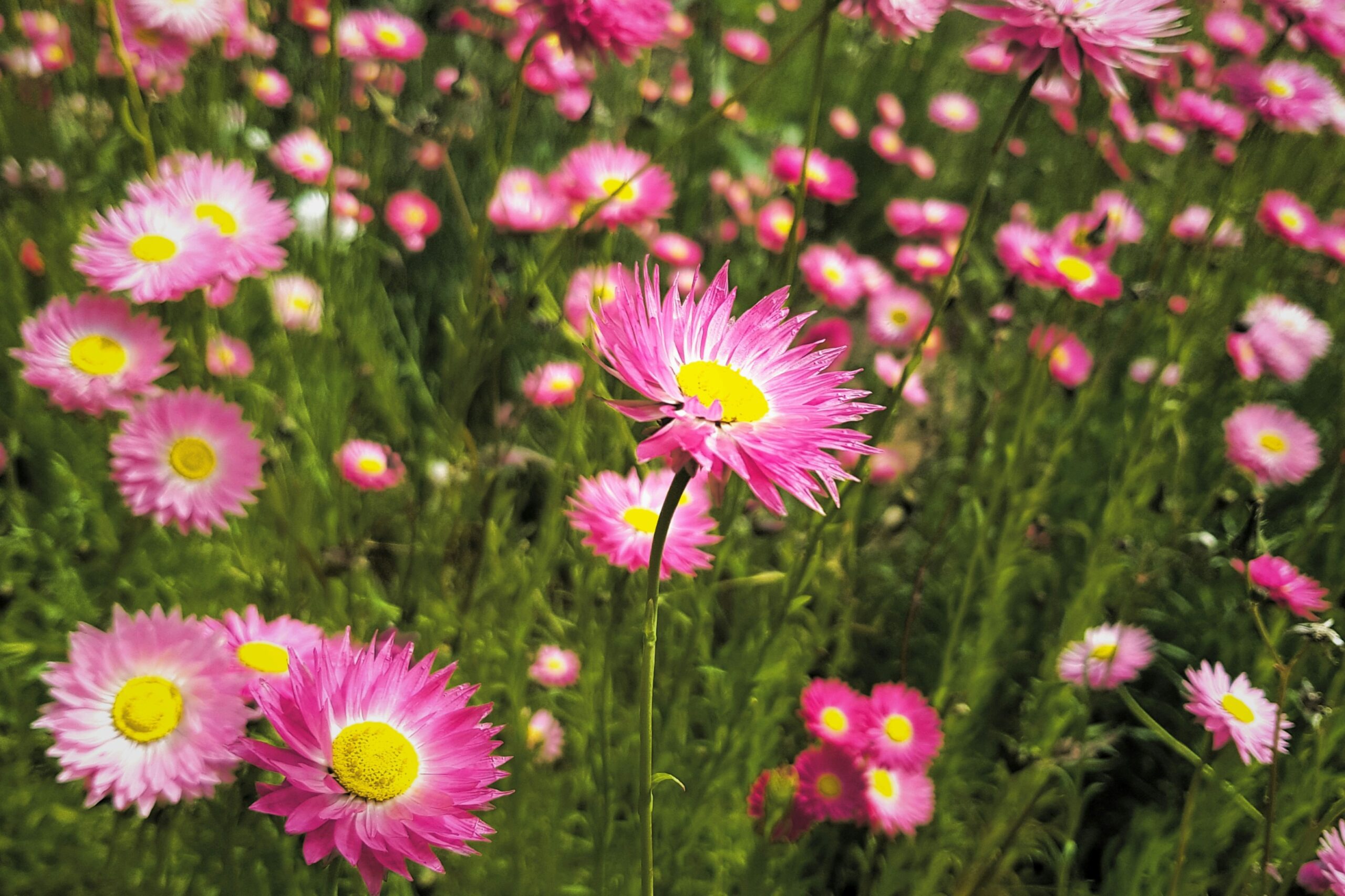
The Mid West and northern Wheatbelt — the arc through Mullewa, Mingenew, Perenjori and Coalseam Conservation Park — is everlasting country, and August is when it makes good on the name. These are annual paper daisies: they germinate on the winter rains, race through their entire lives in a single season, and flower all at once, laying down sheets of pink, white and butter-yellow that can run clean to the horizon. Watch in particular for the pink and white everlasting (Rhodanthe chlorocephala), the pompom-headed golds, and, later in the window, the orange immortelle. Coalseam is the traditional pilgrimage — in a strong year the riverbanks and slopes vanish under colour so completely that the eye keeps trying to correct it, as though someone has been careless with a filter.
August is also the opening of one of the strangest acts in the entire Australian bush: the wreath flowers near Pindar, north-east of Mullewa. These are plants that arrange themselves, entirely of their own accord, into near-perfect flowering rings, as though someone had laid funeral wreaths along the red gravel. We’ll give them the full attention they deserve later in the series. For now, know only that they exist, that nobody has ever managed to grow one in captivity, and that a single stretch of dirt road near Pindar draws thousands of pilgrims a year for exactly this reason.
Closer to home, August announces itself more discreetly: the wattles come into their gold, and the first orchids push up in Perth’s bushland for those who have learned to walk with their eyes down. In the Noongar calendar this is the tail of Djilba, the first, tentative stir of spring.
September – Perth’s month, and you may not need to leave
If you can chase the wave only once, chase it in September, and you can very likely do it inside the city limits.
Perth is one of a mere handful of capital cities on Earth with a genuine wildflower flora of its own. Kings Park is the obvious jewel — hundreds of native species across its bushland, and the Everlasting Kings Park Festival held here every September, one of the longest-running celebrations of native flora anywhere in the country, drawing something close to half a million visitors. But the connoisseurs slip away to the quieter reserves, where the real hunting is. Bold Park at City Beach, where the winter donkey orchids appear in numbers. Wireless Hill in Ardross, where the kangaroo paws stand thick and a whole sequence of orchids emerges in careful succession — greenhoods, then donkeys, then spiders — so that the reserve tells the time by which orchid is out. John Forrest National Park in the hills, the oldest national park in the state, whose Wildflower Walk earns its name without exaggeration, and whose waterfalls are still running from the winter besides.
September is peak orchid season around Perth, peak kangaroo paw season, and the moment the local bush reaches its fullest, most layered colour. Push a little further out — Wave Rock near Hyden, where everlastings and feather flowers gather among the granite; Dryandra Woodland near Narrogin, a wandoo woodland rich in banksias and orchids that also happens to be one of the last strongholds of the numbat — and the displays broaden into something you could lose a weekend in.
October – the season goes south, and saves its best scenery for last
As Perth begins to warm and dry, the wave breaks in the Great Southern, and the season, with a fine sense of theatre, keeps its grandest landscapes for the finale.
The Stirling Range, rising abruptly and improbably from flat farmland near Albany, holds one of the richest floras of anywhere its size on Earth — roughly 1,500 species in a single range — including the mountain bells, a group of flowers so local that some grow on one peak and no other place in the universe. The Fitzgerald River National Park, strung along the coast between Bremer Bay and Hopetoun, is a UNESCO-listed biosphere reserve where the heath performs feats of colour and architecture that simply have to be witnessed. And the Albany and Esperance coasts carry the display right through into November, setting royal hakea, banksias and paws against sand the colour of bleached bone and water an unreasonable shade of blue.
October is also when Perth’s own year quietly turns. The grass trees hoist their tall flower spears, and the Western Australian Christmas tree — a golden, fire-coloured oddity we’ll come to — begins to glow along the roadsides. In the Noongar calendar this is Kambarang, the second spring: the season named, quite literally, for the abundance of flowers.
A small piece of insider craft
Here is the trick the seasoned wildflower chasers use and the day-trippers never learn. Don’t guess. The season is tracked, in near real time, by people whose job it is: the state’s visitor centres publish rolling wildflower reports through spring, and the small community resource centres up north — Mullewa’s especially — put out updates on the everlasting carpets and the wreath flowers as they come and go. Read those the way a surfer reads a swell forecast. A wildflower field peaks for perhaps a week or two and then quietly sets seed and browns off, and the difference between arriving in that window and arriving a fortnight late is the difference between the photograph of your life and a paddock of dry stalks.
The whole thing on the back of an envelope
- Chasing the carpets? North, August into September — Coalseam and the Mid West.
- Chasing orchids and city bushland? Stay put, September — Kings Park, Bold Park, Wireless Hill, John Forrest.
- Chasing grand landscapes and rare heath? South, October into November — Stirling Range, Fitzgerald River, Albany, Esperance.
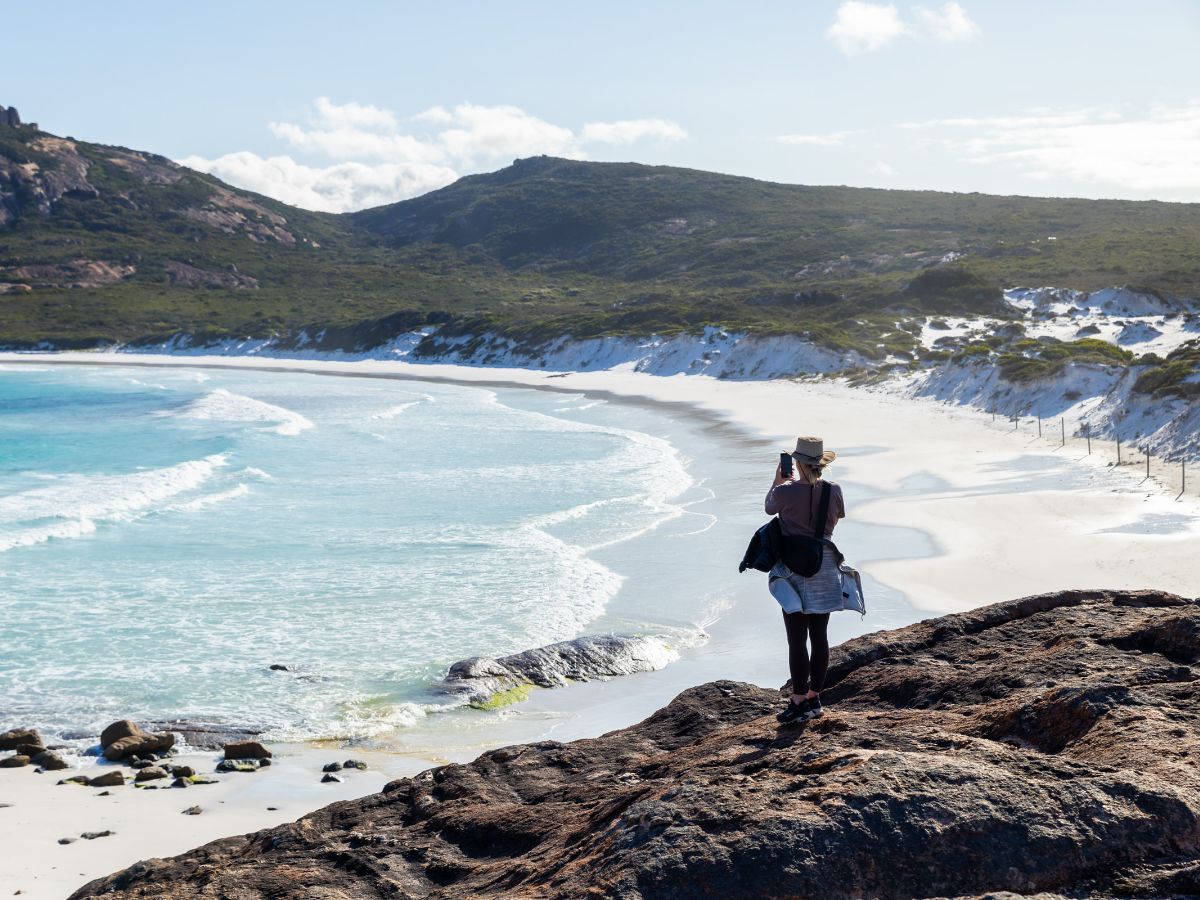
Follow that simple southward drift and you can open your spring standing in a pink Mid West paddock in the first week of August and close it, three months later, on a wildflower-strewn southern headland with the Southern Ocean at your feet. The same season, walked from top to bottom, at the pace it was always meant to be taken.
Which is the real secret hidden inside the tourism slogan. The wildflowers are magnificent, yes. But the genuinely rare thing on offer here is time — a spring slowed down and stretched across four months and a thousand kilometres, so that for once you are not racing to catch it before it goes. You are simply walking alongside it as it goes.