10th September 2026
The Suspiciously Effective Business of Going for a Walk
There is something faintly ridiculous about the fact that one of the most effective things I can do for my brain involves putting on shoes and leaving the house.
No subscription, or seven step protocol. No special equipment beyond footwear and, depending on the season, an unreasonable amount of discussion about whether it might rain.
Just walking.
Preferably somewhere green.
I have been watching the effects of this for ten years now, and at some point I quietly started referring to it as magic. Not because I believe hiking possesses supernatural properties, or because I am about to suggest you align your chakras with a jarrah tree. I call it magic because the effect often seems disproportionately large compared with the input.
You arrive at a trailhead as one person and return to the car as a slightly different one.
Nothing has actually changed. Your mortgage still exists, your children still require feeding, and your inbox has almost certainly multiplied in your absence. That difficult conversation still needs to happen and the washing has not, despite being left alone for several hours, developed the initiative to fold itself.
And yet something has changed. You can think again.
This is peculiar enough that I think it deserves our attention.
We have become very good at treating normal human needs as luxury items
Modern life has performed an impressive piece of marketing on us. It has convinced us that being permanently contactable, sedentary, indoors, overstimulated and mildly frantic is normal, while spending two hours walking through the bush is an indulgence.
Think about that.
We will sit at a desk all day, drive home, answer emails while making dinner, look at one screen while another screen plays in the background, go to bed exhausted, wake up tired and conclude that perhaps what we really need is a magnesium supplement.
Maybe.
Or perhaps the ape needs to go outside.
I realise that is not a particularly sophisticated wellness strategy, but sophistication and effectiveness are not always the same thing. We humans have a strange tendency to trust solutions in proportion to their complexity. If something requires an app, a membership, specialised equipment and a man on a podcast explaining mitochondria, it feels serious. “Go outside for a walk” sounds suspiciously like advice your grandmother would give you.
Unfortunately for the wellness industry, Grandma may have had a point.
In 2019, researchers analysed data from almost 20,000 people in England and found that people who reported spending at least 120 minutes in nature during the previous week were significantly more likely to report good health and high wellbeing than those who reported no nature contact. Interestingly, it didn’t seem to matter whether those 120 minutes came in one glorious escape or were accumulated in smaller visits across the week.
Two hours.
For perspective, two hours is roughly one film, several episodes of whatever series you are currently “just watching one more” of, or the amount of time it takes to enter IKEA for three tea lights and emerge having questioned the entire direction of your life.
Two hours in nature is not an enormous intervention.
But the association was substantial enough to make researchers pay attention.
And they aren’t the only ones.
Research into nature exposure has linked time in natural environments with reductions in stress, improvements in mood and attention, and a range of other wellbeing outcomes. The science is still evolving, and anyone claiming that a forest walk will cure everything from burnout to your tax return should probably be avoided. But the broad picture is becoming difficult to ignore.
Humans appear to do rather well outside.
Who could have seen that coming?
The brain, apparently, enjoys being taken for a walk
Then there is the walking itself.
A Stanford study famously found that walking increased creative output by an average of around 60 per cent compared with sitting. Importantly, the effect wasn’t entirely about being surrounded by majestic mountains and inspirational sunsets. Participants walking on a treadmill indoors also performed better on tests of divergent thinking.
Movement itself appeared to change the way people thought.
This explains quite a lot.
It explains why ideas arrive in the shower. Why problems sometimes untangle halfway around the block. Why the perfect response to an argument appears approximately 47 minutes after the argument has ended, usually while you are walking the dog.
The brain seems to like a bit of physical momentum.
And yet when we have a difficult problem to solve, what do most of us do?
We sit harder.
We stare at the computer with increased determination, as though the answer might eventually emerge from the spreadsheet if we establish sufficient eye contact.
We have built entire industries around helping people think better while keeping them almost perfectly still.
There are productivity systems, focus apps, standing desks, supplements, noise-cancelling headphones and morning routines of such complexity that they appear to require their own project manager.
Meanwhile, an embarrassingly effective piece of cognitive technology remains available outside the front door.
Legs.
But this is where the research becomes personal for me
I can give you the studies, and I find them fascinating. But long before I knew the numbers, I had watched the experiment play out in front of me thousands of times.
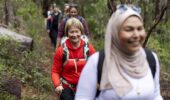
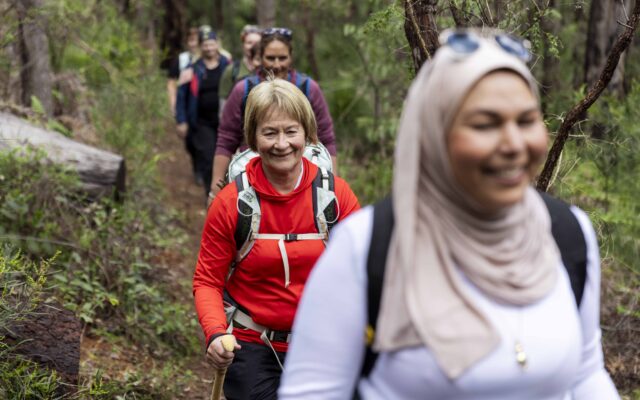
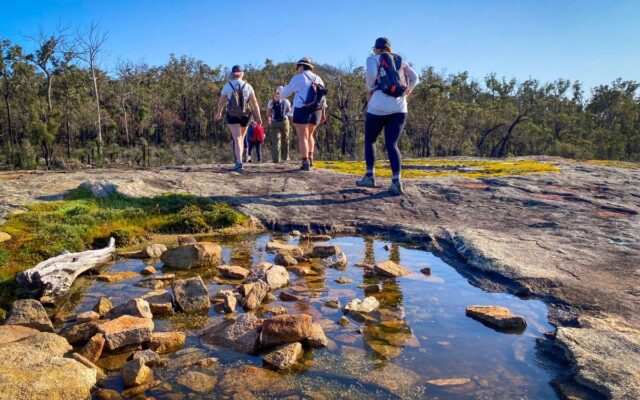
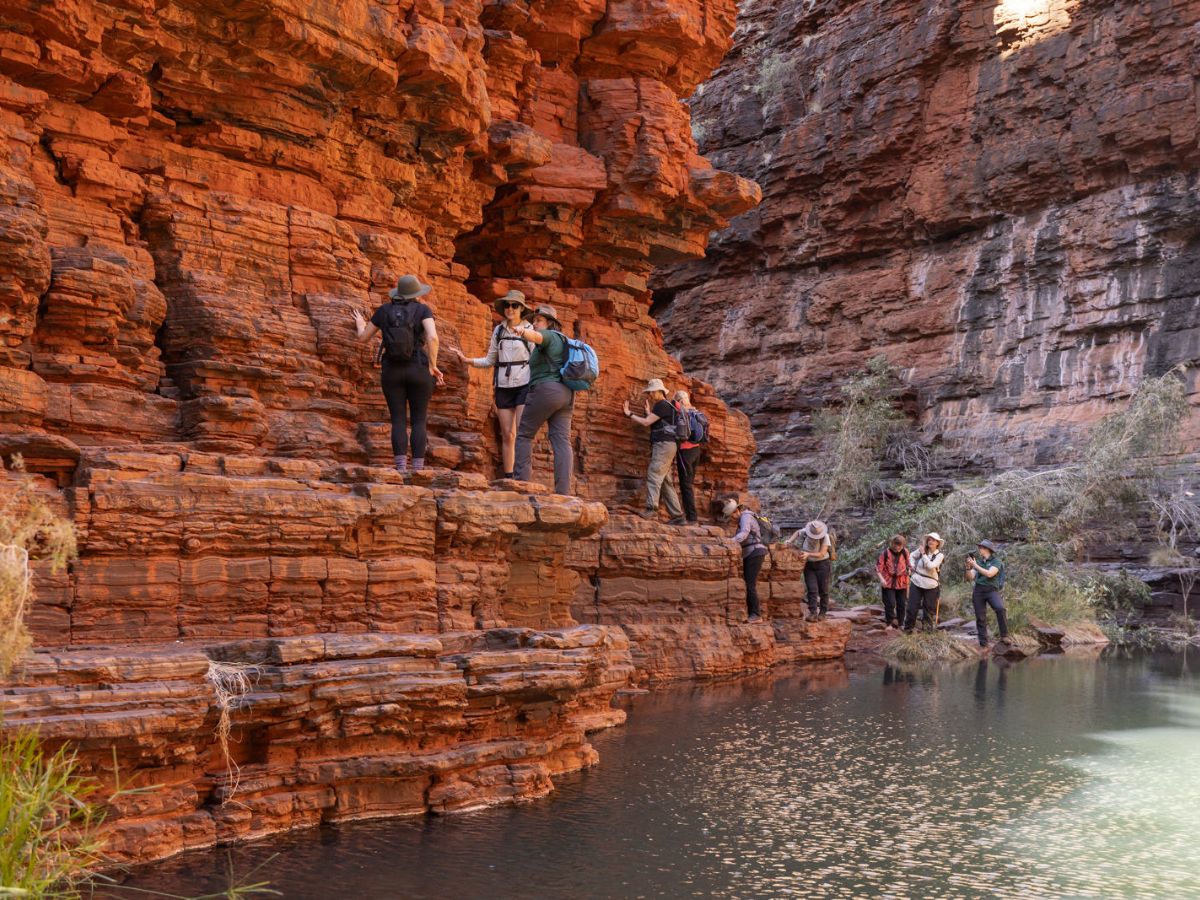
People arrive at our hikes carrying the usual evidence of being a modern human. They are rushing. They are checking phones. They are wondering whether they brought enough water. Some are apologising in advance for being “unfit”. Others are standing slightly apart because they have come alone and haven’t yet worked out who to talk to.
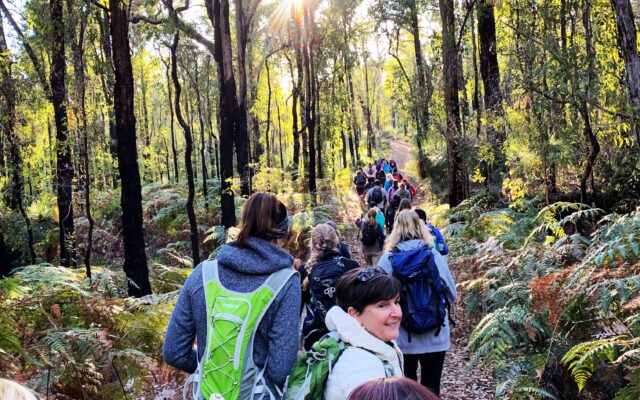
And then we start walking.
The change is rarely dramatic. Nobody disappears behind a grass tree and emerges spiritually enlightened.
It is much more ordinary than that.
Someone starts talking.
Someone else, perhaps more importantly, stops.
People fall into pace beside each other. Conversation begins with the safe subjects – where do you live, have you done this trail before, is that hill as steep as it looks — and then, strangely often, wanders somewhere much more interesting.
Walking side by side does something that sitting opposite someone doesn’t.
There is no requirement for constant eye contact. Silence isn’t awkward because there is always something to look at. The landscape absorbs the gaps in conversation. You can tell someone something surprisingly personal and then spend the next five minutes debating whether the thing beside the trail is a seed pod or animal poo.
Nature is very good at keeping us humble.
This matters because social connection is not some fluffy bonus feature of a good life. It is increasingly recognised as a significant contributor to health and wellbeing. In 2023, the US Surgeon General went so far as to publish an advisory describing loneliness and social disconnection as a serious public health concern.
Perhaps one reason walking works so well is that it quietly bundles several useful things together.
You move your body. You go outside. You pay attention to something other than yourself. You often talk to another human being. You encounter a little uncertainty. You occasionally have to climb something you would rather not climb.
And at the end, you have evidence that you did.
That is quite a lot of return for putting on a pair of shoes.
I am particularly interested in the people who tell me they are “not hikers”
We hear this all the time.
“I’d love to come, but I’m not really a hiker.”
I have never completely understood what administrative process people imagine is involved in becoming one.
Is there a licence?
A practical assessment?
Does somebody from Parks and Wildlife arrive at your house and ask you to identify three types of gaiter?
At what point does walking become Hiking, and when are you legally permitted to put it in your Instagram bio?
The outdoor industry has perhaps not helped itself here. We have managed to make one of the most basic human activities look remarkably technical. There are poles, packs, hydration systems, GPS watches, merino layering strategies and shoes with names suggesting they were designed for a military operation in the Andes.
All useful in the right circumstances.
But for many people, the greatest barrier to getting outside is not physical.
It is identity.
They don’t see themselves as the sort of person who does this.
This is one of the things I love most about watching beginners on a trail. The transformation isn’t that they suddenly become wilderness athletes. It is much quieter and, I think, much more important.
They discover they can.
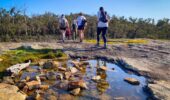
There is a hill. They climb it.
There is a distance. They walk it.
There is a morning when they nearly cancelled because they didn’t know anyone. They come anyway.
And somewhere along the way, the story they tell themselves gets edited.
Not dramatically.
Just enough.
Perhaps I am someone who does things like this.
That sentence can travel surprisingly far beyond the trail.
Maybe the magic is actually subtraction
We tend to think wellbeing comes from adding things.
Add yoga. Add meditation. Add supplements. Add journalling. Add breathwork. Add a morning routine. Add a cold plunge if you have recently developed an interest in voluntarily suffering before breakfast.
But what if some of the things that make us feel better work because they remove things instead?
Nature removes quite a lot.
Walls, for one.
Notifications, if you have the good sense to ignore them.
Advertising. Traffic. Artificial light. The expectation that you should be productive every minute of the day.
It removes the strange modern habit of having six things competing for your attention simultaneously.
Perhaps this is why people often tell us after a hike, “I feel like myself again.”
That sentence fascinates me.
Because it suggests we haven’t added anything at all.
We have simply removed enough noise for something familiar to reappear.
Maybe hiking doesn’t make you a better version of yourself.
Maybe, for a few hours, it stops so many other things getting in the way.
Nature also has a rather useful way of correcting scale
There is another phenomenon researchers have become increasingly interested in: awe.
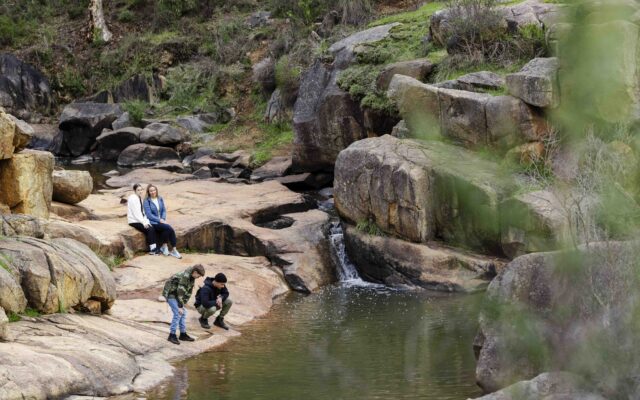
Awe is what happens when we encounter something that feels vast enough to exceed our usual frame of reference. A huge night sky. An ancient tree. A gorge. The ocean disappearing into the horizon.
Research has associated experiences of awe with greater wellbeing and a reduced focus on the self. You become, temporarily, a little less central to the universe.
I think this is an underrated benefit.
Most of our problems are experienced from extremely close range. We hold them six inches from our face and inspect them repeatedly.
Then you stand somewhere enormous.
A landscape does not solve your problem. But it does resize it.
This is particularly effective with ancient landscapes.
There is something wonderfully clarifying about standing beside a geological formation that has survived several hundred million years and remembering that the email you are catastrophising about was sent on Tuesday.
The email may still matter.
But perhaps not quite as much as it did at 2am.
So, is hiking actually magic?
Obviously not.
And also, perhaps, yes.
Magic is often simply the name we give something before we understand the mechanism.
We now understand plenty of the mechanisms. Movement affects the brain. Nature exposure appears to influence stress and wellbeing. Social connection matters. Awe changes perspective. Doing difficult things builds evidence of capability. Attention behaves differently when it isn’t being mugged by a notification every 90 seconds.
None of this requires mysticism.
But explanation does not necessarily diminish wonder.
We know how sunsets work. They remain ridiculous.
We understand enough about stars to know they are enormous balls of plasma undergoing nuclear fusion, and still people stand beneath them and whisper, “Wow.”
Perhaps knowing why something works makes it more remarkable, not less.
After ten years of The Hike Collective, I no longer think the real product is kilometres.
It isn’t the trail.
It isn’t even hiking, really.
It is the moment at the end when someone says the four words I have heard more times than I can count:
“I really needed that.”
They rarely know exactly what “that” was.
The walking? The trees? The conversation? The silence? The view? The fact that they did something for themselves? The fact that, for three hours, nobody could reasonably expect them to unload the dishwasher?
Probably all of it.
Which is inconvenient for those of us who like neat explanations.
But I think that is why I started calling it magic in the first place.
Not because we don’t know how it works.
Because something so ordinary probably shouldn’t work quite this well.
And yet, somehow, it does.