7th September 2026
The Beginner’s Mind, and How To Carry It Home From The Trail.
A ninety-second encounter with a honeybee in the Darling Range taught me more about attention than a decade of guiding. Here, I trace the idea back to a small temple in San Francisco, and explain how a walk can be made to last long after the boots come off.
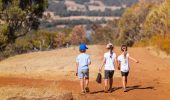
Last spring, on one of our Darling Range walks, a man I had never met stopped the whole group for a flower.
He was a first-timer. You could tell from the boots, which were new, and from the way he stood a little apart at the car park briefing with his arms folded. When I asked what had brought people out that morning, he said “my wife” and left it at that.
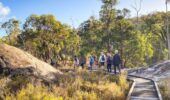
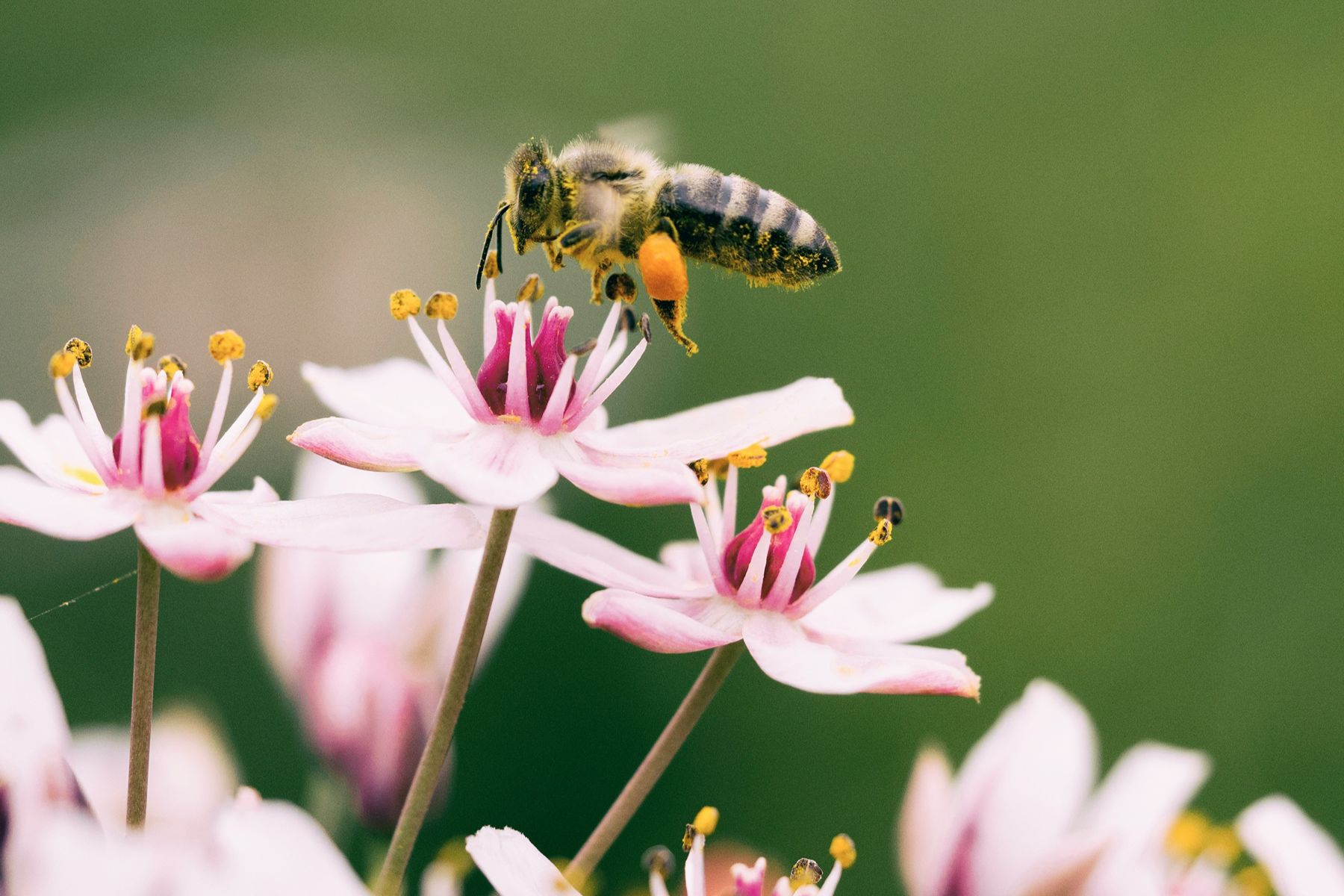
Two hours in, on the floor of a gully where the track narrows under jarrah and everyone walks single file, I noticed the line behind me had broken. I walked back expecting a shoelace. Instead he was crouched at the edge of the path, hands on his knees, looking at a small yellow bush pea. On it was a honeybee. He did not look up when I arrived. After a while he said, to nobody in particular, “it’s got bags on its legs.”
It did: two of them, one on each hind leg, packed with pollen the colour of mustard.
The rest of the group drifted back and stood around him in a loose ring, and I did what a guide should do in that moment, which is nothing. 90 seconds later the bee lifted off and we moved on, but the walk had changed. People kept stopping, and the pace slowed. The man with the folded arms talked to three different people before the car park, and I heard him say the word “bags” at least twice more, laughing at himself.
I have led walks in Western Australia for ten years. I could not have engineered that moment if I had tried, and I have tried. It took me some time to understand what I had watched, and the understanding came from an unexpected direction.
A temple in San Francisco
The old word for what happened to him is shoshin. It is Japanese, and it translates as something like “beginner’s mind” or “beginner’s heart,” depending on who is doing the translating.
The idea comes from Zen Buddhism, and in particular from a teacher named Shunryu Suzuki. In 1959 he arrived in San Francisco from Japan to take charge of a small temple serving the city’s Japanese community. To his surprise, the people who turned up to sit with him in the early mornings were mostly young Americans who had no idea what they were doing. He liked that about them, and he said so. In 1970 a collection of his talks was published as Zen Mind, Beginner’s Mind, and one sentence from it has travelled further than the rest: in the beginner’s mind there are many possibilities, but in the expert’s mind there are few.
That line has been quoted often enough to lose its edge. Read in context, it is sharper than its reputation. Suzuki was not claiming that beginners are better than experts. He was pointing at something more uncomfortable: the moment you decide you know what a thing is, you stop seeing it. You see your idea of the thing instead, and your idea is smaller, and older, than the thing itself. He asked his students to sit down each morning as though they had never sat before, not because the first time was special, but because the first time is the only time a person is fully present.
He also thought this was difficult. Not a trick to be learned once, but a practice that slips away by lunchtime and has to be recovered, again and again.
The man in the gully had almost certainly arrived with a story about himself. I am not a walking person. I am here because I was signed up. This is not for me. Whatever the story was, it did not survive the bee. For 90 seconds he did not know what he was looking at, and he did not pretend to, and the afternoon was different for it.
The child on the track
Anyone who has walked a bush track with a small child will recognise the mechanism. A six-year-old covers perhaps a third of the ground an adult covers in an hour, and not because their legs are short. Every 20 metres, something requires investigation. A stick that might be a sword. A rock with a hole through it. An ant hauling a dead moth four times its own size across the path.
My own child is like this, and I confess I sometimes find it challenging. I now think the child is doing the walk correctly, and I was doing something else: a kind of moving administration, in which the track was a corridor between the car and the lookout and most of my attention was on the parking ticket.
A child has not yet built the filing system. A bee is not yet “a bee,” a thing already understood and therefore not worth a second look. It is this bee, on this flower, about to do something the child cannot predict, and so they watch to see what it does. Most of us lose this somewhere around the age of ten, at roughly the point where we begin to get good at things. Suzuki would have said the two facts are related.
What the man was looking at
For the record, and because he made me go and find out, here is what was happening on that flower.
Honeybee foragers are all female. This one would have flown from a hive that might have been 3 or 4 kilometres away, and before returning she would work her way through somewhere between 50 and 100 flowers. At each one she combed pollen from her body with the bristles on her legs, moistened it with a little nectar so that it would hold together, and pressed it into a hollow on each hind leg that beekeepers call a basket. Fully loaded, the two baskets can weigh close to a third of her own body weight. She flies home like that.
Had we been in a different part of the range, we might instead have seen one of Western Australia’s own. The blue-banded bee, Amegilla cingulata, is a solitary native with iridescent bands across its abdomen, and it pollinates in a way the honeybee cannot. It clamps onto a flower, disengages its wings, and vibrates its flight muscles until the pollen shakes free. Researchers at the University of Adelaide filmed the behaviour at high speed and found the bee strikes the flower with its head around 350 times a second. From a metre away it sounds like a short zip. Kangaroo paw depends on it.
None of this is visible at 4 kilometres an hour with your eyes on the track. All of it is visible to someone who has stopped, crouched, and set aside for two minutes the assumption that they know what a bee is.
The same all the way down
A kilometre further on, the same group stopped again, this time for a fern, and this time without anyone leading.
Bracken fills the damp gullies of the Darling Range and the shaded tracks at Yanchep, and it may be the most overlooked plant in the state. Nobody sees a bracken frond; they see a green wall at knee height and push through it. But hold a single frond up to the light and it is built in a curious way. The frond divides into leaflets. Each leaflet divides again into smaller leaflets. Each of those, at its edge, repeats the pattern once more at a scale you have to squint to see. The plant is made of smaller copies of itself, nested four deep.
The mathematician Benoit Mandelbrot gave that property a name in 1975: a fractal. Once you have the word, the bush is full of them. A marri’s branches against a white sky. A creek dividing as it descends a slope. Lichen on granite. Richard Taylor, a physicist at the University of Oregon, has spent much of his career demonstrating that the human body responds to these patterns, and that looking at fractals of roughly the complexity nature produces most often brings measurable reductions in stress. I am not qualified to assess his methods. I can report that a woman on our walk held a frond against the sky for a full minute and said, “it’s the same all the way down,” and that she did not sound stressed when she said it.
What a guide can and cannot do
I said I could not have made the bee happen, and that remains true. The moment cannot be scripted. I have watched guides try, halting a group at a marked point to announce that everyone should now take a moment to really notice, and you can feel 14 people politely agreeing to notice, which is a different thing entirely.
What a guide can do is arrange the conditions. This, once the first aid and the permits are dealt with, is most of what the job is.
You walk more slowly than the group wants to in the first half hour, so that the pace is already broken before anyone finds a bee. You choose ground uneven enough that feet have to concentrate, because heads tend to follow feet. You pick the track where the labels run out, where people do not know what that plant is or whether that bird is a wattlebird, and where there is no reception to check. You resist filling the silence. When someone crouches, you do not hurry them, and you do not explain the bee until they ask.
Then, and this is the part I have only learned in the last few years, you name it. Not in the gully. Later, at the car park or over the lunch you are now late for, you say something like: that thing you did with the bee, where you didn’t know what it was and simply watched. You can do that with anything. You can do it with your kitchen.
Because the bee is not the point. The bee was in a gully in the Darling Range, and the man lives in a suburb, and he is not returning to the gully each time he needs to feel the way he felt there. What he can take home is the shape of the thing. Stop for something that does not deserve stopping for. Do not decide what it is. Give it 90 seconds.
This is what we are really trying to send people home with. Not the view; views fade within a week. What lasts is a small piece of practice that became attached to a good day and gets used again on an ordinary one, bringing a little of the good day back with it each time. It is how a walk is made to outlast the walk.
Try it on Tuesday
If you are on a track this week, anywhere at all, you could do what the man did. Not the view. Something you could touch. Give it 90 seconds. See whether it has bags on its legs.
Then try it on Tuesday, at your desk, with whatever happens to be on your desk.
If you would rather not begin alone, The Hike Collective’s Social Hike runs free every month, thanks to our Wild Access Project. Nobody there will mind if you hold up the line.