14th July 2026
The Colour Code: What Wildflowers Are Really Saying
Here is a small idea that will quietly ruin your ability to look at a wildflower the innocent way ever again: the colours are not for you. That red is not there to be admired. That blue is not a matter of taste. Every colour in the bush is a signal, precise, deliberate, and aimed at a specific customer who is very much not you. Once you learn to read it, a hillside of wildflowers stops being decoration and becomes a conversation you’ve been permitted, briefly, to overhear.
Because a flower, stripped of romance, is an advertisement. A plant cannot walk to a mate; it must instead persuade something that can walk, or fly, to carry its pollen from one flower to the next. Colour is the medium of that persuasion. And since different pollinators see the world through profoundly different eyes, a flower’s colour tells you, with surprising reliability, exactly who it is trying to reach. A flower’s colour, in other words, is not a matter of taste. It is a matter of target market.
Red is for the birds
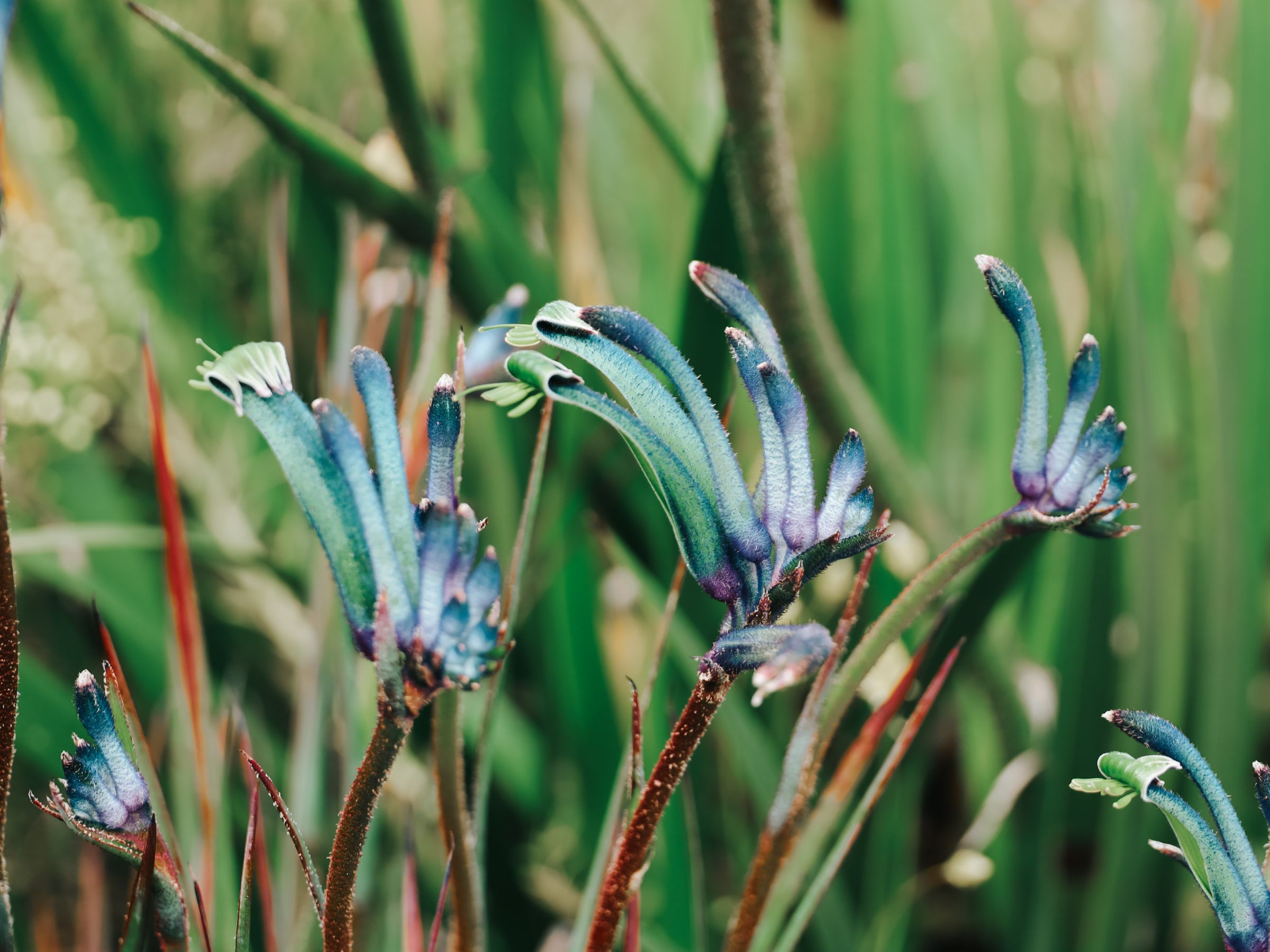
Start with the boldest signal in the whole bush: red and orange. The flaming kangaroo paws, the scarlet banksias, the vivid grevilleas. These are, overwhelmingly, flowers built for birds, and specifically for our honeyeaters.
This is neither coincidence nor whim, and it is genuinely rare on a global scale. In most of the world, red flowers are surprisingly uncommon, for one deceptively important reason: the insects that do the lion’s share of pollinating, bees above all, are effectively red-blind. To a bee, a red flower struggles to stand out from the surrounding green leaves; it reads as a kind of dull nothing. So across most of the planet, choosing to be red is simply bad advertising, a billboard your best customers can’t see.
But birds see red magnificently. And here is where Western Australia becomes properly extraordinary. This is one of the great global strongholds of bird pollination. A far larger share of our plants are pollinated by birds, and even by small nectar-feeding mammals, than almost anywhere else on Earth. When researchers modelled Australian flowers through the actual eyes of Australian birds, they found something remarkable: our bird-pollinated flowers have converged, over deep evolutionary time, on a distinctive band of long-wavelength reds that a honeyeater’s particular colour vision picks out with special ease against a green background. The flowers and the birds have, in effect, agreed on a private frequency, and been broadcasting on it for millions of years.
So when you see a flame-red flower here, you are not merely admiring a colour. You are looking at a landscape that decided, in the deep past, to be pollinated by birds, and dressed accordingly. Those robust, tubular, nectar-heavy proteas we keep meeting, built to be perched on and drunk from by a beak rather than landed on by a bee? Red is their uniform, and the honeyeater is their intended reader.
Blue and purple are for the bees
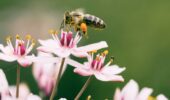
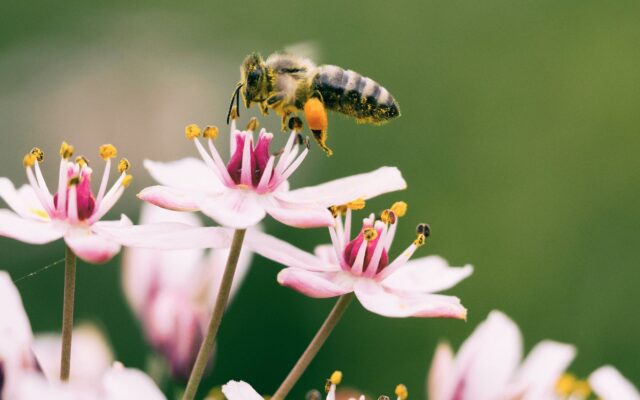
Now turn to the blues and purples, the electric leschenaultias, the fan flowers, the blue china orchids. These, by and large, are aimed at bees, and they trade on the oldest colour preference in the entire pollination business.
Bees possess excellent vision at the blue and violet end of the spectrum, and a deep, hard-wired attraction to it. Bee eyes and blue flowers have been co-evolving for tens of millions of years, since long, long before the first honeyeater ever dipped its beak into a paw. When you kneel to a blue leschenaultia, you are reading an advertisement written in the most ancient visual language flowers possess, in a hand that predates the birds entirely.
The signage you’ll never see
And now the part that ought to unsettle you a little, in the best way. A great many flowers are not, to their intended customers, the colour you see at all. They are covered in patterns of ultraviolet, invisible to human eyes but blazing to a bee, that function like the landing lights on a runway, drawing the insect down and inward to the precise spot where the nectar and pollen wait. Botanists call them nectar guides. A flower that looks to you like a plain, simple yellow may be, to the bee hovering above it, an elaborate bullseye with a glowing arrow at its centre reading land here.
Sit with that for a moment. The flower in front of you is broadcasting instructions in a colour you were born unable to perceive, to a customer you can barely see, in a transaction that predates your species by an almost unfathomable margin. You are not the audience. You never were. You are simply, on this walk, an unusually large and clumsy eavesdropper, and the bush does not mind, because it isn’t talking to you.
The colour that’s missing
Here’s a puzzle to test the code on. The feather flowers (Verticordia), those exquisite, fringed, woolly-edged blooms that are among the glories of the WA sandplains, come in an astonishing range of colours: white, cream, lemon, gold, apricot, pink, and a scarlet so intense it seems lit from within. Nearly a hundred species, almost every one of them found only in Western Australia. And yet, across the entire genus, there is a single colour you will never find: blue. Not one blue feather flower exists.
Why? Partly because blue is genuinely hard to make. A true blue is one of the rarest achievements in the whole plant kingdom; it takes a particular and fiddly chemistry that most plant lineages simply never evolved. And the feather flowers belong to one of those lineages. They sit in the myrtle family, the great Australian clan that also gives us the eucalypts, the bottlebrushes and the paperbarks, and for all its exuberance with red, white, yellow, pink and purple, that family almost never manages a true blue. The missing colour, in other words, is less a marketing decision than an inherited limit: there are simply some shades the feather flowers were never handed the chemistry to paint. (The name Verticordia, incidentally, means “turner of hearts,” an old epithet of Venus, which feels about right for a flower that runs through every warm colour in the box and pointedly skips the cool one.)
Which is worth holding onto, because it complicates the colour code in a satisfying way. A flower’s colour is shaped by two forces at once: not only who it is trying to attract, but what pigments its ancestry has left it able to build. The absences in the bush, it turns out, are as legible as the presences. You simply have to know that some colours are choices, and others are just chemistry.
Why the WA bush is so vivid
All of which finally explains a feeling every visitor has and almost none can name: that the colours here seem somehow more. More saturated, more surprising, more unreasonable than a spring has any right to be.
Part of it is simple arithmetic: the sheer number of species flowering at once, thousands of separate advertisements competing for attention in the same few weeks. But a large part is that unusually high rate of bird pollination, which floods the bush with big, loud, high-contrast reds and oranges that a more bee-dominated flora, elsewhere in the world, would never trouble to produce. Our landscape is loud because it is shouting at birds. And birds, unlike bees, like it loud.
So the next time you stand in a Western Australian spring and feel that the colour is almost too much to take in, that it tips over from beautiful into something faintly overwhelming, understand that you are exactly right, and now you know why. You are standing inside an advertising war that has been running for millions of years, waged in a spectrum half of which you cannot even see, between plants that cannot move and the birds, bees and small furred creatures they have spent an eternity learning to persuade.
Crack the colour code, and the bush is never merely beautiful again. It is talking, and you have just learned enough of the language to catch a word here and there.